Enzyme inhibition is a decrease in an enzyme-catalyzed reaction rate caused by an inhibitor. In the classical Michaelis–Menten framework, competitive inhibition increases the apparent Km without changing Vmax, while pure noncompetitive inhibition decreases Vmax without changing Km. Other inhibition mechanisms give different patterns.
What Is Enzyme Inhibition?
An inhibitor reduces enzyme activity by interacting with an enzyme, an enzyme–substrate complex, or another component of the assay. Reversible inhibitors can dissociate; irreversible inhibitors may inactivate an enzyme through a covalent or otherwise long-lasting process. Competitive, uncompetitive, noncompetitive and mixed refer here to reversible kinetic models. Allosteric regulation, tight binding, time-dependent inhibition and complex enzyme mechanisms may not follow these simple patterns. NCBI Assay Guidance Manual describes the experimental distinctions.
Competitive Inhibition Explained
In the ideal competitive model, an inhibitor binds free enzyme (E) but not the enzyme–substrate complex (ES). The inhibitor often occupies the substrate-binding site, although a competitive kinetic pattern alone does not establish a precise binding location. Increasing substrate concentration can overcome inhibition in this reversible model.
Kinetic signature: apparent Km increases and Vmax does not change. A Michaelis–Menten graph shifts to the right but approaches the same maximum rate.
Noncompetitive Inhibition Explained
Pure noncompetitive inhibition means the inhibitor binds free E and ES with equal affinities (Ki = Ki′). The apparent Vmax decreases, while the apparent Km remains constant. Importantly, the common textbook shortcut “binds outside the active site = noncompetitive” is not a sufficient kinetic definition.
If an inhibitor binds both E and ES with unequal affinities, the general pattern is mixed inhibition. Mixed inhibition reduces apparent Vmax, but its effect on apparent Km depends on the relative affinities. The model distinguishes a special pure noncompetitive case from the wider mixed class. See the peer-reviewed review of enzyme-inhibition models.
Uncompetitive Inhibition Explained
In the ideal uncompetitive model, the inhibitor binds only to ES, forming an inactive enzyme–substrate–inhibitor complex. Both apparent Km and Vmax decrease by the same factor. Unlike classical competitive inhibition, raising [S] does not eliminate uncompetitive inhibition.
Competitive vs. Noncompetitive vs. Uncompetitive Inhibition
| Model | Inhibitor binds | Apparent Km | Apparent Vmax | High [S] removes inhibition? |
|---|---|---|---|---|
| Competitive | Free E | Increases | Unchanged | In the ideal reversible model, yes |
| Pure noncompetitive | E and ES equally | Unchanged | Decreases | No |
| Uncompetitive | Only ES | Decreases | Decreases | No |
| Mixed | E and ES unequally | Increases or decreases | Decreases | Not fully in the general model |
This table assumes a single-substrate, classical steady-state reversible-inhibition scheme and compares apparent parameters at a fixed inhibitor concentration. Source: NCBI Assay Guidance Manual, inhibition-model summary.
How Does Enzyme Inhibition Change Km and Vmax?
The Michaelis–Menten equation for a simple uninhibited enzyme is:
Vmax is the limiting initial rate as [S] becomes saturating. Km is the substrate concentration at half Vmax for this simple model. Km is a kinetic parameter, not universally a direct measure of binding affinity.
For an ideal reversible inhibitor that can bind free enzyme and/or ES, a useful general equation is:
α = 1 + [I]/Ki and α′ = 1 + [I]/Ki′
This gives the apparent parameters:
Vmax,app = Vmax / α′
Here Ki describes inhibitor binding to E and Ki′ describes binding to ES. Competitive inhibition sets α′ = 1; uncompetitive inhibition sets α = 1; pure noncompetitive inhibition uses α = α′. The equations are model-dependent and should not be imposed automatically on real enzymes.
Michaelis–Menten vs. Lineweaver–Burk Graphs
A Michaelis–Menten graph directly shows how the initial rate responds to [S]. A Lineweaver–Burk plot graphs 1/v against 1/[S]. In the ideal competitive model, reciprocal lines share a y-intercept (1/Vmax); for pure noncompetitive inhibition, they share an x-intercept (−1/Km); and for uncompetitive inhibition, they are parallel. However, taking reciprocals amplifies measurement error at low [S]. Direct nonlinear fitting is generally more appropriate for estimating kinetic parameters.
Interactive Enzyme Inhibition Simulator
Select an inhibition mechanism, move the inhibitor concentration slider, and compare the resulting curve with the no-inhibitor control. The model uses synthetic demonstration parameters, not experimental enzyme data.
Interactive plot requires JavaScript.
Fixed example parameters: Km = 4; Vmax = 100; Ki = 5; Ki′ = 12 for uncompetitive/mixed binding. Pure noncompetitive uses Ki = Ki′ = 5. All concentrations use a common arbitrary unit; initial velocity uses arbitrary units. Model: v = Vmax[S] / (αKm + α′[S]). No enzyme-specific inhibition constant is estimated here.
Enzyme Science in a 1915 Japanese Textbook
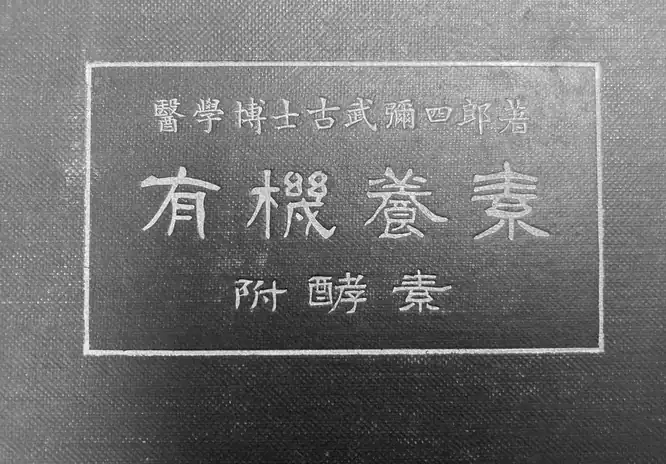
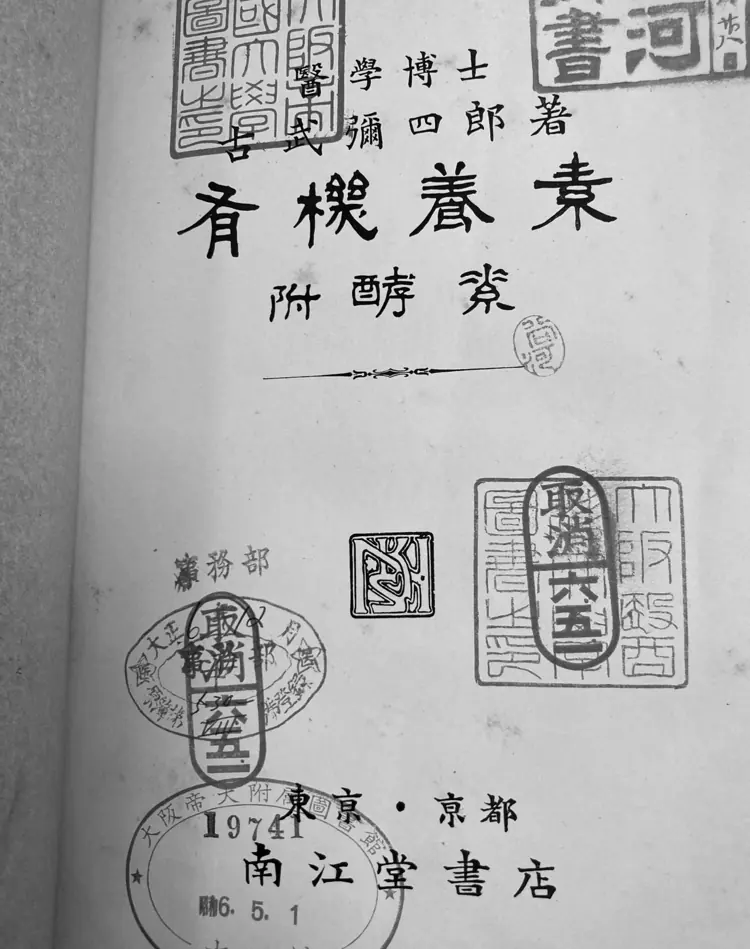
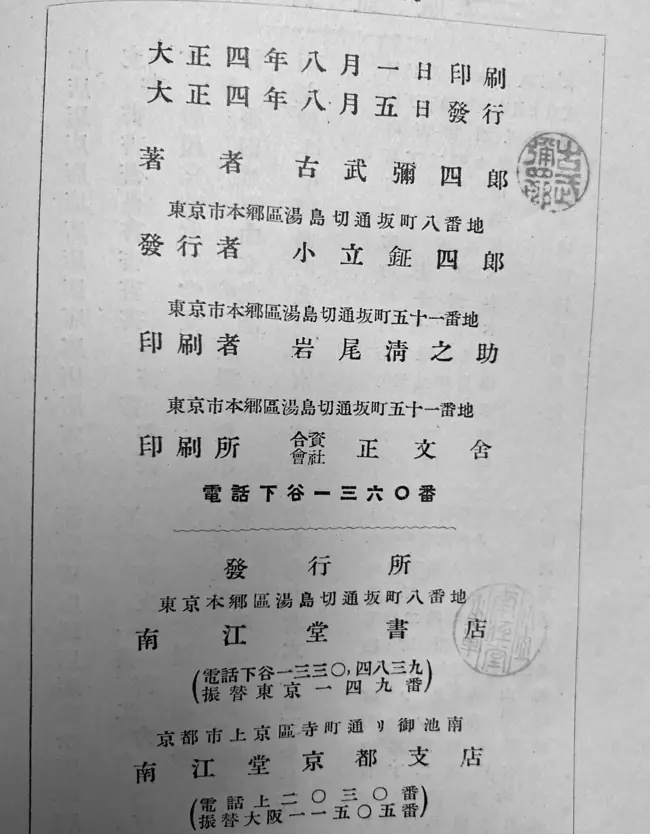
Our physical copy of 有機養素 附 酵素 (approximately, “Organic Nutrients, with an Appendix on Enzymes”), by 古武彌四郎, records a publication date of August 5, 1915 (Taishō 4) and lists Nankōdō (南江堂) as its publisher. These are facts visible in the photographed copy, not a claim that the book originated modern inhibition theory.
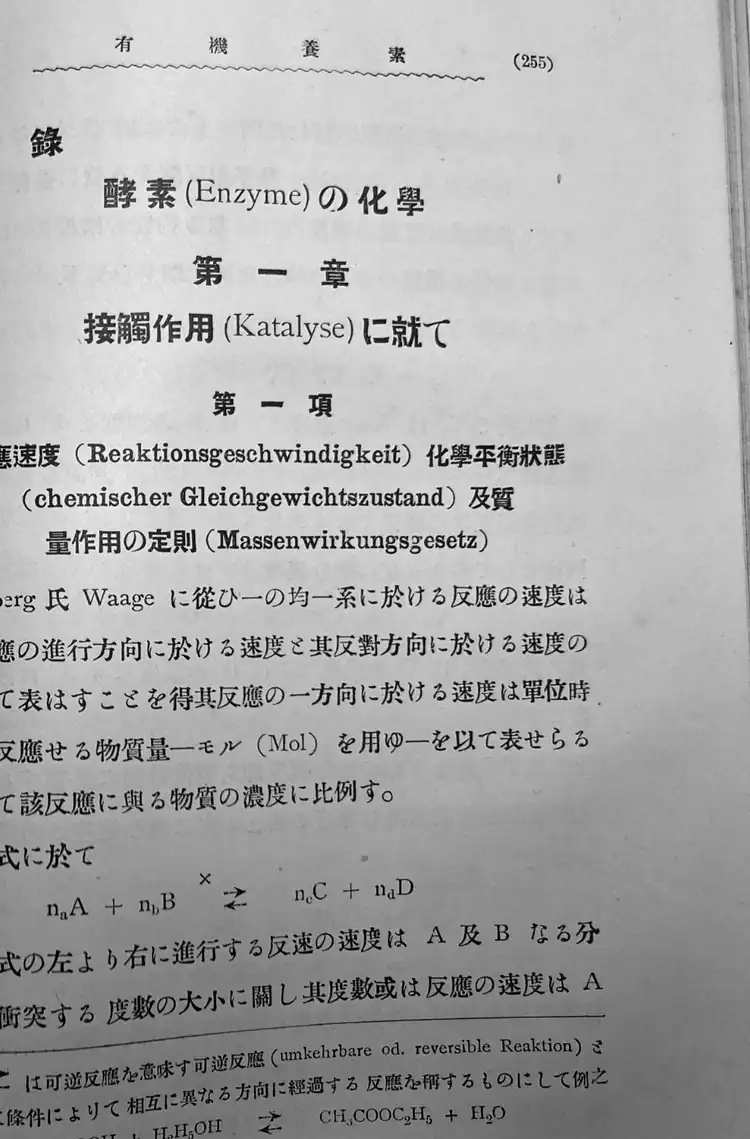
The enzyme appendix opens on page 255 with discussions of catalysis, reaction velocity, chemical equilibrium and the law of mass action, citing Guldberg and Waage. The adjacent pages formulate forward and reverse reaction rates in terms of reactant concentrations. These topics remain basic building blocks of chemical kinetics, but they are not themselves an explanation of modern competitive and noncompetitive inhibition.
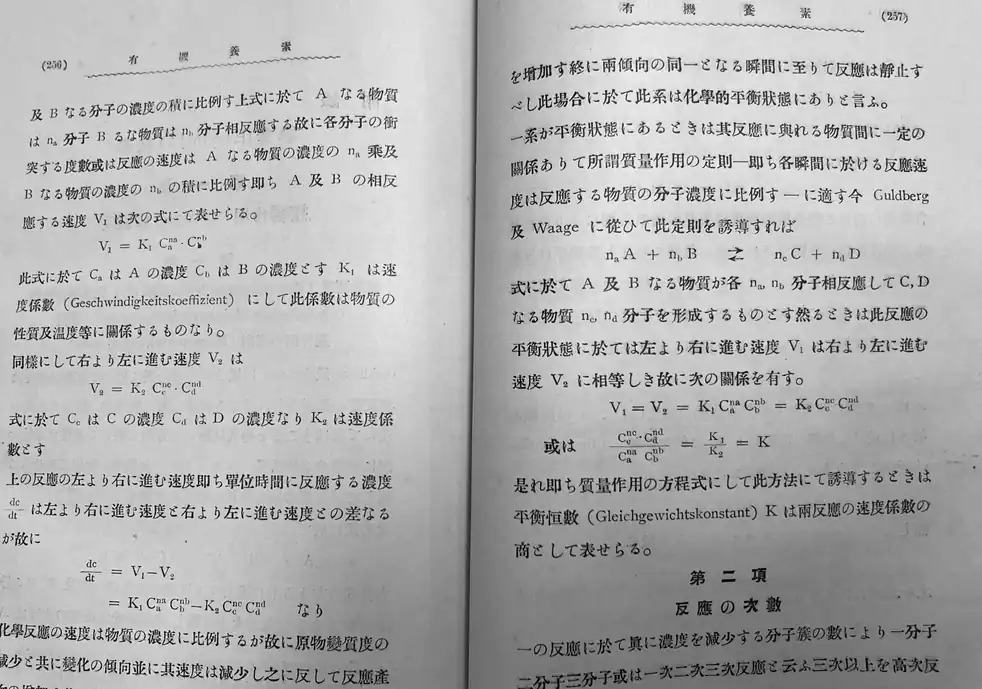
Later in the photographed appendix, the text also discusses enzyme activators (Aktivatoren), including concepts such as zymogens and activation conditions. This shows the breadth of enzyme-related questions scientists were already investigating, without establishing that this edition described today's four ideal reversible-inhibition classes.
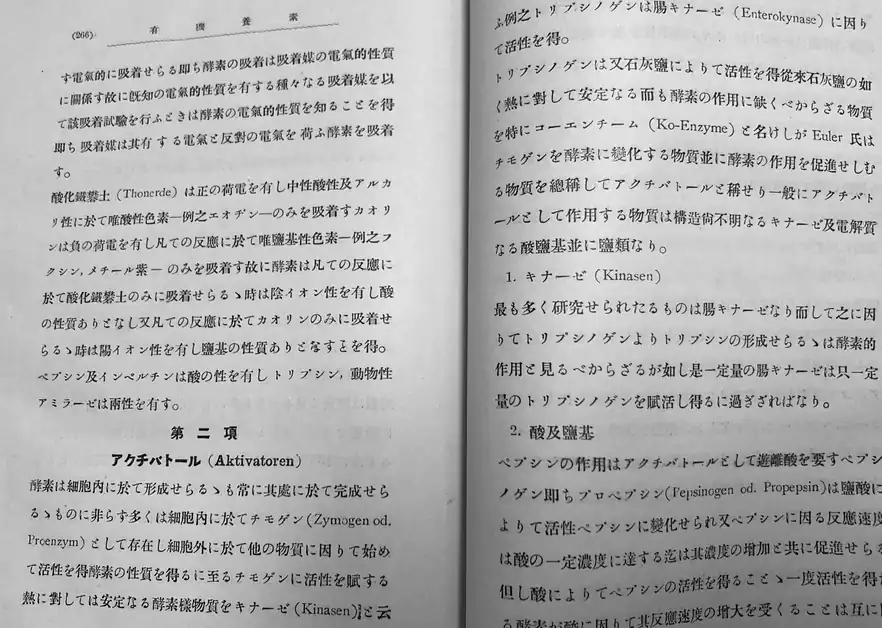
The original text and modern discussion serve different purposes: the book documents what was being taught in 1915; the equations, inhibition types and interactive graphs above use modern, carefully defined kinetic models.
Enzyme Inhibition Practice Quiz
Answer 10 randomly selected multiple-choice questions about competitive, pure noncompetitive, uncompetitive and mixed inhibition, Km, Vmax and kinetic plots. Each question has three options and exactly one correct answer. Feedback appears immediately; use Next question to continue even after an incorrect answer.
The interactive quiz requires JavaScript.
Frequently Asked Questions
- What is the difference between competitive and noncompetitive inhibition?
- In the ideal competitive model, the inhibitor binds free enzyme, raises apparent Km, and leaves Vmax unchanged. Pure noncompetitive inhibition decreases apparent Vmax without changing Km.
- Does competitive inhibition increase Km or decrease Vmax?
- Classic reversible competitive inhibition increases apparent Km but does not alter Vmax.
- What happens to Km and Vmax in uncompetitive inhibition?
- Both decrease in the same proportion in the ideal uncompetitive model.
- What is mixed enzyme inhibition?
- Mixed inhibition means the inhibitor can bind free enzyme and the enzyme–substrate complex with unequal affinities. Apparent Vmax decreases; apparent Km may rise or fall.
- What does a Lineweaver–Burk plot show?
- It plots 1/v versus 1/[S]. The intersections and slopes can illustrate ideal inhibition patterns, but reciprocal plots are less reliable than nonlinear fitting for many real data sets.
- Can the simulator estimate my enzyme's Ki?
- No. It shows synthetic model curves with fixed example values. Estimating Ki requires suitable experimental initial-rate measurements and model fitting.
Related Biochemistry Practice
Review the building blocks of proteins in our 20 Amino Acids Structure Quiz, or practice biological molecules with the DNA and RNA Structure Quiz. Both complement an introduction to enzyme function.
Sources and Editorial Notes
- Strelow J. et al. “Mechanism of Action Assays for Enzymes.” Assay Guidance Manual, NCBI Bookshelf. Experimental and kinetic definitions of inhibition modes.
- “Assessment of Enzyme Inhibition: A Review with Examples from the Development of Monoamine Oxidase and Cholinesterase Inhibitory Drugs.” Discussion of pure noncompetitive vs. mixed inhibition and experimental interpretation.
- OpenStax, Biology 2e, section 6.5: Enzymes. Introductory explanations of enzyme regulation.
- Historical primary source: 古武彌四郎, 有機養素 附 酵素, 南江堂, photographed copy with colophon dated August 5, 1915. Figures are compressed photographs of the original book held by the author; no printed text has been redrawn.
Editorial distinction: the 1915 book is cited only for content visible in the supplied photographs. Modern inhibition classifications and formulas are based on the contemporary references above. Educational content only.