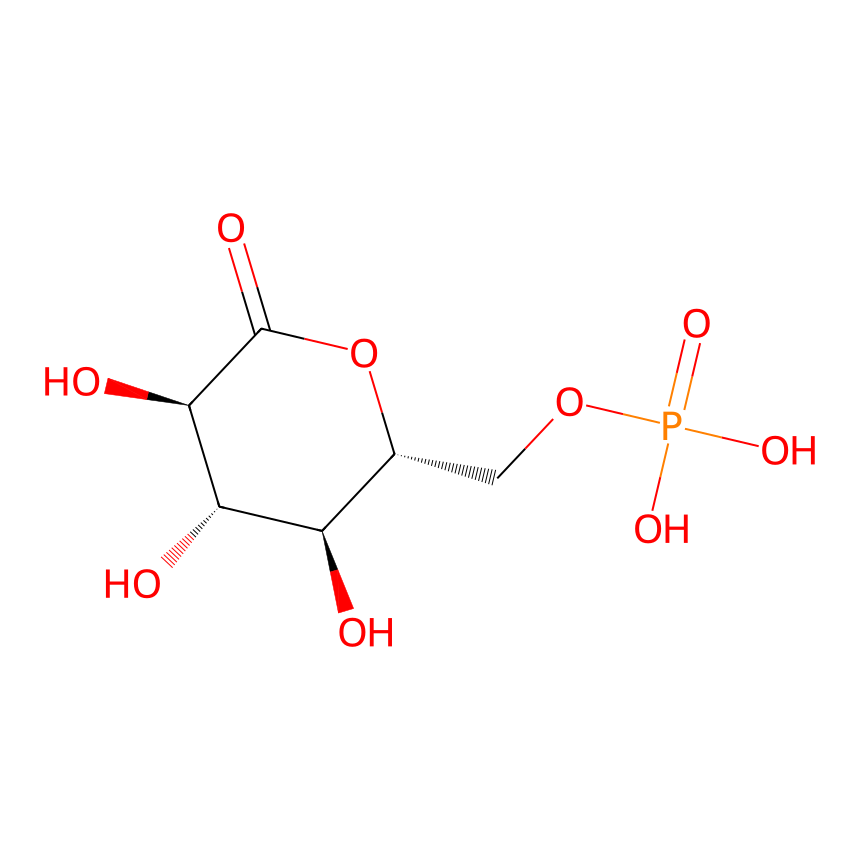
Can you identify the intermediates of the pentose phosphate pathway (PPP) from their chemical structures? Practice the oxidative and non-oxidative phases in this free eight-reaction quiz.
What does the pentose phosphate pathway produce?
The oxidative phase converts glucose-6-phosphate to ribulose-5-phosphate and produces two NADPH and one CO₂ per glucose-6-phosphate. The reversible non-oxidative phase interconverts sugar phosphates, providing ribose-5-phosphate for nucleotide synthesis and linking to glycolysis through fructose-6-phosphate and glyceraldehyde-3-phosphate.
Interactive Pentose Phosphate Pathway Quiz
Follow the vertical sequence of structure cards and enzyme arrows. For every reaction, choose the correct structure from three options. Some reactions have two products: choose the matching product pair. All eight reactions are included. The two transformations of ribulose-5-phosphate are parallel branches, not consecutive reactions; the branch-point notes mark this explicitly.
Loading interactive quiz…
Key facts to remember
- G6PD initiates the oxidative phase and generates NADPH.
- 6-phosphogluconate dehydrogenase generates another NADPH and releases CO₂.
- Ribulose-5-phosphate can form either ribose-5-phosphate (isomerase) or xylulose-5-phosphate (epimerase).
- Transketolase requires thiamine pyrophosphate (TPP) and transfers two-carbon units; transaldolase transfers three-carbon units.
- The non-oxidative phase is reversible. Reaction arrows in this exercise are one useful direction, not an assertion that all cells have the same flux.
Continue learning metabolism
Review the glycolysis chemical-structure quiz and the TCA cycle quiz to connect the pentose phosphate pathway with central carbon metabolism.
Scientific references
Reactome: Pentose phosphate pathway (human). The eight-reaction arrangement and the non-oxidative carbon-transfer reactions follow this curated pathway.