How many chromosomes do humans have? Most human body cells have 46 chromosomes arranged in 23 pairs. A typical sperm or egg contains 23 chromosomes. The difference comes from meiosis, the cell division process that produces reproductive cells.
Human Chromosome Number: 46 Chromosomes in 23 Pairs
A chromosome is a long DNA molecule packaged with proteins. Humans ordinarily inherit one copy of each autosome from each biological parent. The 23rd chromosome pair comprises the sex chromosomes, most commonly XX or XY, although other chromosome complements occur.
Here is a simplified 23-pair chromosome chart. Each box represents a pair, not two accurately scaled chromosomes.
Schematic illustration only; chromosome shapes and relative sizes are not to scale. Sex-chromosome pairs need not contain matching chromosome types.
46 vs. 23 Chromosomes: What Is the Difference?
| Cell type | Typical chromosome number | Meaning |
|---|---|---|
| Most nucleated body cells | 46 (2n) | 23 pairs, diploid |
| Sperm | 23 (n) | One set, haploid |
| Egg | 23 (n) | One set, haploid |
| After fertilization, typical zygote | 46 (2n) | 23 from each gamete |
Mature red blood cells are an important exception: they have no nucleus, so they have no nuclear chromosomes. Some other cells can also depart from the simple diploid model.
Why Are There 23 Chromosomes in Sperm and Eggs?
Meiosis reduces the chromosome set from diploid (2n) to haploid (n). When a sperm and egg combine, the resulting zygote normally contains two sets again. A chromosome is counted by its centromere: after DNA replication, each replicated chromosome has two sister chromatids but is still counted as one chromosome until those chromatids separate.
Mitosis vs. meiosis: mitosis usually preserves chromosome number in daughter nuclei; meiosis reduces ploidy during the production of gametes. To explore genetic inheritance afterward, use our Punnett Square Calculator and Practice Quiz.
Why Did Scientists Once Think Humans Had 48 Chromosomes?
For decades, 48 was commonly accepted as the human diploid chromosome count. Early microscope preparations often contained overlapping chromosomes that were difficult to distinguish. In 1956, Joe Hin Tjio and Albert Levan published evidence supporting 46 as the normal human diploid number. Later work confirmed it. This was a revision of a scientific measurement, not a sudden evolutionary change in human chromosome number.
The historical account is described by Nature Education and the National Human Genome Research Institute.
What Did a 1930s Japanese Cell Biology Book Teach?
We examined our photographed copy of Ippan Saibōgaku (一般細胞學; General Cytology) by Gihei Yamaha, first published in 1933. The photographed copy is a later edition. Chapter 13, Chromosomes and Heredity, begins on page 605. The pages supplied for this article discuss chromosome behavior, variation in chromosome number, and examples of polyploid organisms.

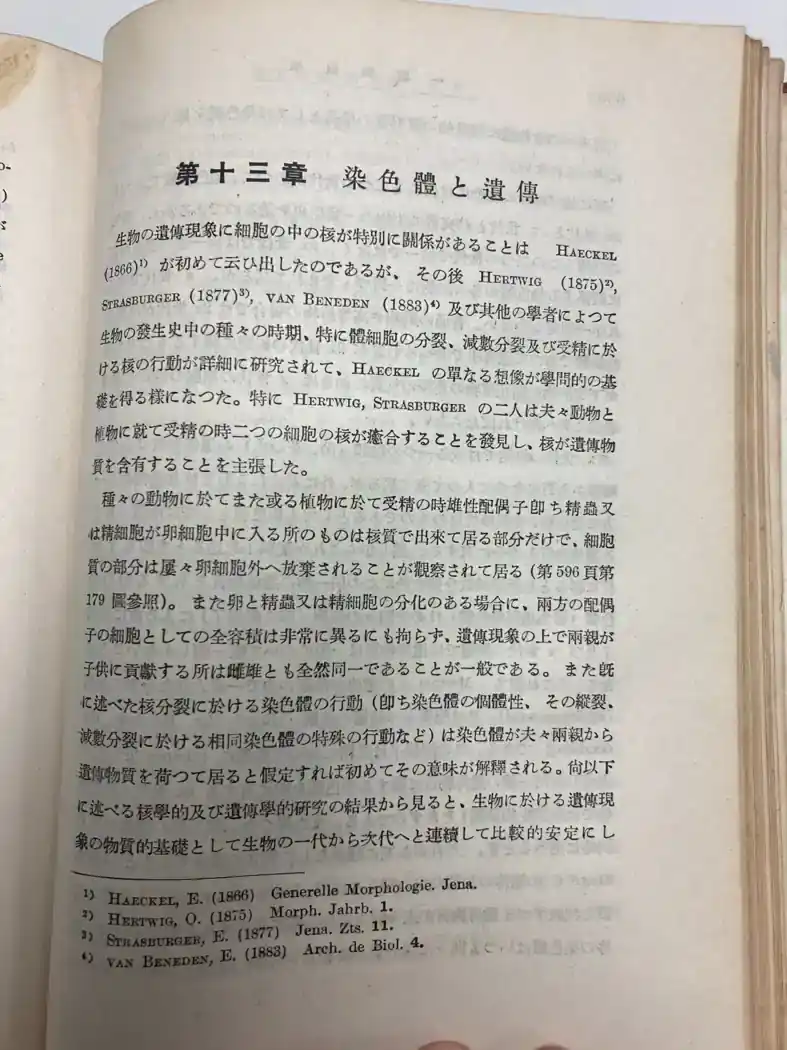
Important source distinction: the pages we photographed do not establish that Yamaha explicitly stated the human chromosome count was 48. We therefore use this book to document what chromosome biology was being discussed in Japan at that time, while tracing the historical 48-to-46 correction to separately cited research.
Do All Species Have 46 Chromosomes?
No. Chromosome counts vary across organisms, and more chromosomes do not automatically mean greater complexity. The photographed book shows chromosome comparisons among plant species and a discussion of changes in chromosome number. These historical figures are useful for understanding how researchers compared organisms before genome sequencing.
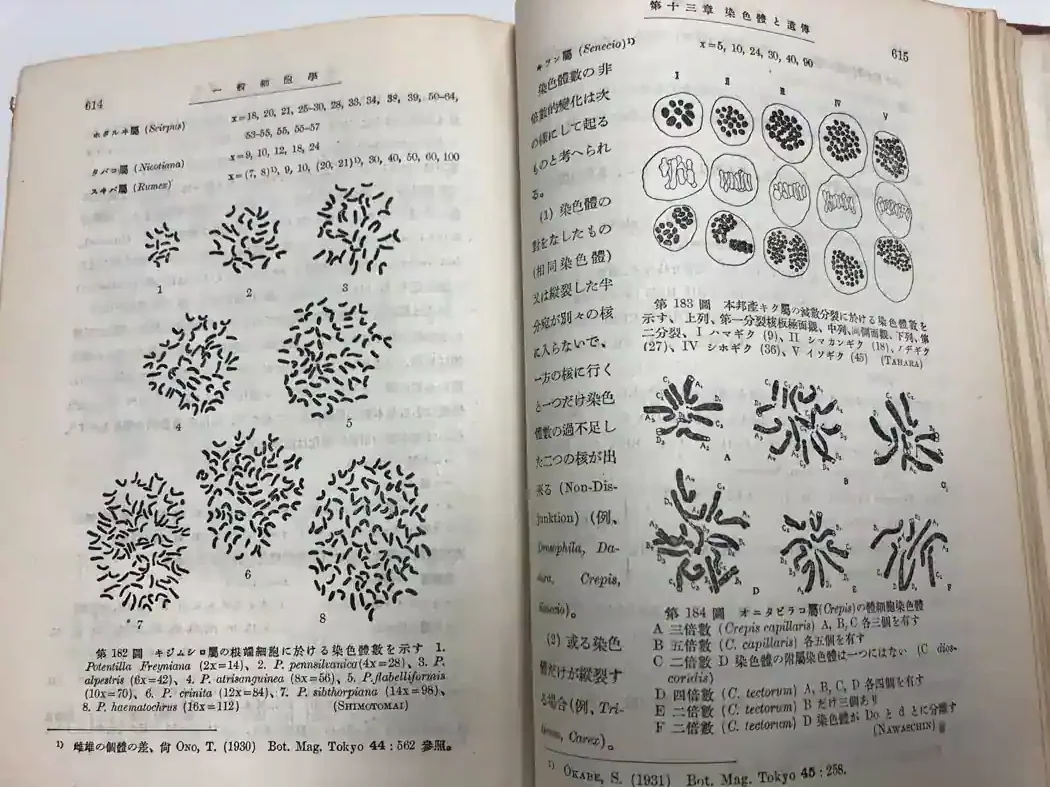
Aneuploidy vs. Polyploidy: How Can Chromosome Number Change?
Aneuploidy means gaining or losing individual chromosomes relative to the usual set. For example, most cells in a person with trisomy 21 have three copies of chromosome 21, normally totaling 47 chromosomes. Polyploidy means having additional complete chromosome sets, such as 3n or 4n. Polyploidy is particularly important in plants.
Yamaha's book discusses haploid, diploid, triploid and tetraploid states and gives examples from plants; these terms remain central to cytogenetics today.
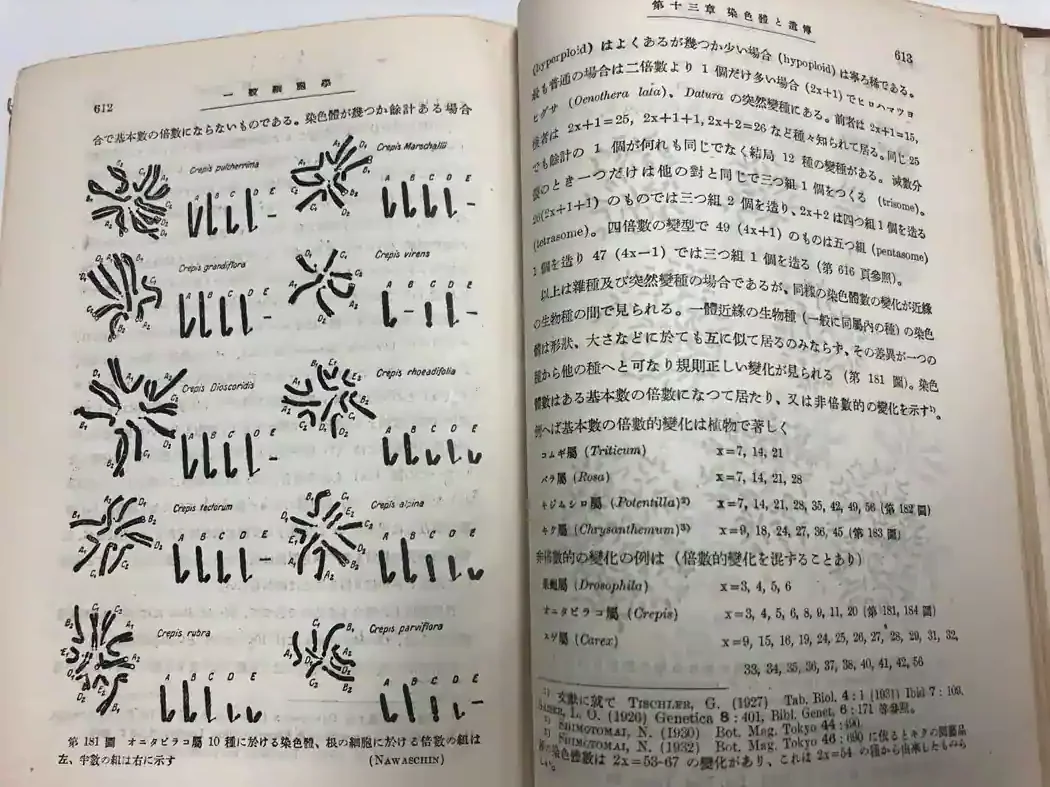
For the medical distinction between typical chromosome counts and aneuploidy, see MedlinePlus Genetics.
Chromosome Number Practice Quiz
Test your understanding with 10 interactive questions on 46 versus 23 chromosomes, diploid and haploid cells, meiosis, the historical 48-chromosome claim, and polyploidy. Each question has three answer choices and exactly one correct answer. Results and explanations appear after you answer.
Loading the chromosome quiz…
Frequently Asked Questions
Do humans have 23 or 46 chromosomes?
Both numbers describe different cell types: most human nucleated body cells have 46 nuclear chromosomes, while a typical egg or sperm has 23.
Do all humans have exactly 46 chromosomes?
No. Forty-six is the typical diploid count; chromosome-number variations and mosaicism occur, and mature red blood cells lack a nucleus.
Why do humans have 23 pairs of chromosomes?
Typically, one chromosome of each pair is inherited from each biological parent. Fertilization combines two sets of 23, producing 46 in the resulting zygote.
What happens if someone has 47 chromosomes?
The effect depends on which chromosome is extra and on the cells affected. Trisomy 21 is one example; 47 chromosomes alone is not a diagnosis.
Does chromosome count measure how advanced a species is?
No. Chromosome number does not provide a reliable ranking of biological complexity.
Study Genetics Next
Continue with our interactive Punnett square calculator to practice inheritance probabilities. You can also review DNA structure with our DNA and RNA structure quiz.
Sources and Notes
Historical primary source: Gihei Yamaha, 一般細胞學 (General Cytology), Shōkabō, first edition 1933, photographed later edition. These scans are of our physical book and are not presented as human karyotype images. Contemporary references: MedlinePlus Genetics: How many chromosomes do people have?; MedlinePlus Genetics: How do cells divide?; Nature Education: Human Chromosome Number; and MedlinePlus Genetics: Chromosomal conditions.