What is the difference between saturated and unsaturated fats? Saturated fatty-acid chains contain no carbon–carbon double bonds, while unsaturated chains contain one or more. A monounsaturated fatty acid has one; a polyunsaturated fatty acid has two or more. The number, position, and cis/trans geometry of these bonds can change how a fat packs, melts, and behaves in biology.
Examples include palmitic acid (16:0) and stearic acid (18:0) for saturated fatty acids, oleic acid (18:1) for monounsaturated fatty acids, and linoleic acid (18:2) for polyunsaturated fatty acids. Foods contain mixtures of fatty acids, so “saturated fat” and “unsaturated fat” describe predominant composition rather than completely separate substances.
This guide combines modern lipid chemistry with photographs from a 1915 Japanese biochemistry book, an interactive fatty-acid explorer, a comparison chart, and a 10-question practice quiz. Learn the modern definitions first, then see what chemists knew more than a century ago.
Saturated vs. Unsaturated Fats: What Is the Difference?
A fatty acid typically has a carboxyl group (–COOH) at one end and a hydrocarbon chain. Its carbon–carbon bonding pattern gives the simplest structural distinction between saturated and unsaturated fatty acids. Most naturally occurring unsaturated fatty acids in familiar vegetable oils have cis double bonds, which introduce bends in the chain.
Saturated fatty acids
All chain carbon–carbon bonds are single bonds. Many long-chain saturated fats pack comparatively well and are often solid near room temperature.
Examples: palmitic acid 16:0; stearic acid 18:0.
Unsaturated fatty acids
At least one carbon–carbon double bond. Cis bonds often reduce packing efficiency, contributing to lower melting points for otherwise comparable molecules.
Examples: oleic acid 18:1; linoleic acid 18:2; α-linolenic acid 18:3.
Important exception: Melting behavior also depends on chain length, double-bond position, stereochemistry, and the full mixture. “All saturated fats are solid and all unsaturated fats are liquid” is a useful classroom generalization, not a universal rule.
Fatty Acid Examples and Structures: 16:0, 18:0, 18:1, 18:2 and 18:3
The notation 18:2 indicates an 18-carbon chain with two carbon–carbon double bonds. A fuller label such as 18:2 (9Z,12Z) also identifies the double-bond positions and cis stereochemistry; “n-6” refers to the position of the first double bond counted from the methyl (omega) end.
| Fatty acid | Shorthand | Molecular formula | Category | Typical sources |
|---|---|---|---|---|
| Palmitic acid | 16:0 | C16H32O2 | Saturated | Palm oil; many animal and plant fats |
| Stearic acid | 18:0 | C18H36O2 | Saturated | Cocoa butter; animal fats |
| Oleic acid | 18:1 (9Z; n-9) | C18H34O2 | Monounsaturated | Olive oil; avocados |
| Elaidic acid | 18:1 (9E; n-9) | C18H34O2 | Trans-monounsaturated | Some partially hydrogenated oils |
| Linoleic acid | 18:2 (9Z,12Z; n-6) | C18H32O2 | Polyunsaturated | Many seed oils; nuts |
| α-Linolenic acid (ALA) | 18:3 (9Z,12Z,15Z; n-3) | C18H30O2 | Polyunsaturated | Flaxseed; chia; walnuts |
These are molecules, not the compositions of whole foods. Olive oil contains several fatty acids; butter contains several fatty acids. A food's predominant fatty-acid pattern may be described as “more unsaturated” or “more saturated.”
Interactive Fatty Acid Structure Explorer
Select a fatty acid to compare its chain length, number of double bonds, chemical formula, and classification.
Unsaturation indicator (up to 3 C=C bonds)
This is a molecular-feature explorer, not an experimentally measured melting-point calculator. The indicator shows double-bond count, not exact molecular geometry.
Why Does a Double Bond Change a Fat's Properties?
For two fatty acids of comparable chain length, cis double bonds can introduce bends that prevent chains from packing together as closely. This helps explain why an oil rich in cis-unsaturated fatty acids may remain liquid at temperatures at which a fat with more saturated fatty acids is solid. Trans double bonds generally leave the chain more extended than corresponding cis bonds, so trans and cis isomers can have different physical properties even when their molecular formulas match.
Oleic acid and elaidic acid are a particularly instructive pair: both are C18H34O2 and both have a double bond at Δ9, but oleic acid is cis and elaidic acid is trans. They are structural stereoisomers, not different chain lengths or different degrees of unsaturation.
Saturated vs. Unsaturated Fats in Foods
The chemistry explains the classification, but dietary advice depends on more than the name of a lipid. Butter, cheese, fatty meat, coconut oil and palm oil tend to supply substantial saturated fat. Olive and canola oils, nuts, seeds and fish are useful sources of unsaturated fats, although every food has a mixed fatty-acid profile.
According to the American Heart Association, replacing some saturated fat with unsaturated fat is a heart-healthier pattern. Replacing saturated fat with industrial trans fat is not an equivalent change. Nor does the absence of animal ingredients automatically make an oil low in saturated fat: coconut and palm oils illustrate the exception. This section summarizes dietary guidance, rather than offering individualized medical advice.
Triglycerides vs. Phospholipids: Both Are Lipids, but They Do Different Jobs
Triacylglycerols (triglycerides) consist of glycerol esterified with three fatty acids. They are major energy-storage lipids. Glycerophospholipids commonly consist of a glycerol backbone carrying two hydrophobic chains and a phosphate-containing polar head group. Their amphipathic structure helps them form cell-membrane bilayers. Not all lipids contain glycerol: cholesterol belongs to the sterol-lipid category and has a fused-ring scaffold.
| Feature | Triacylglycerol (TAG) | Glycerophospholipid |
|---|---|---|
| Common role | Energy storage | Membrane structure, signaling |
| Typical glycerol substitutions | Three fatty-acyl esters | Two hydrophobic chains + phosphate headgroup |
| Overall polarity | Predominantly hydrophobic | Amphipathic |
| Example | Triolein | Phosphatidylcholine (PC; historically often “lecithin”) |
How Are Dietary Fats Digested?
Fat digestion is a good example of the difference between a physical process and a chemical reaction. Emulsification breaks bulk fat into smaller droplets and increases their total surface area; it does not itself cleave the ester bonds in triglycerides. Bile salts help organize fat–water interfaces in the intestine. Pancreatic lipase, assisted by colipase in the presence of bile salts, then hydrolyzes triglyceride ester bonds predominantly at the sn-1 and sn-3 positions, producing free fatty acids and 2-monoacylglycerol. Mixed micelles help transport lipid digestion products through the intestinal aqueous environment toward enterocytes.
These are distinct steps: emulsification → enzymatic hydrolysis → micellar solubilization and absorption. The NCBI Bookshelf review of fat absorption describes the enzymatic mechanism in more detail.
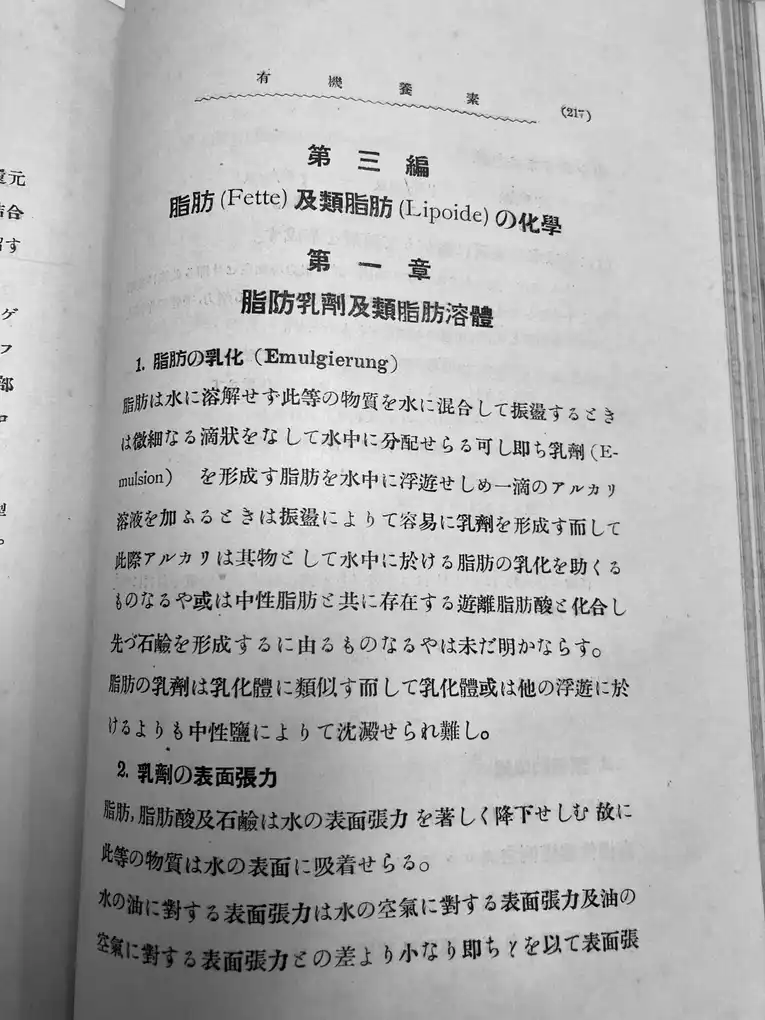
What Did a 1915 Japanese Biochemistry Textbook Know About Lipids?
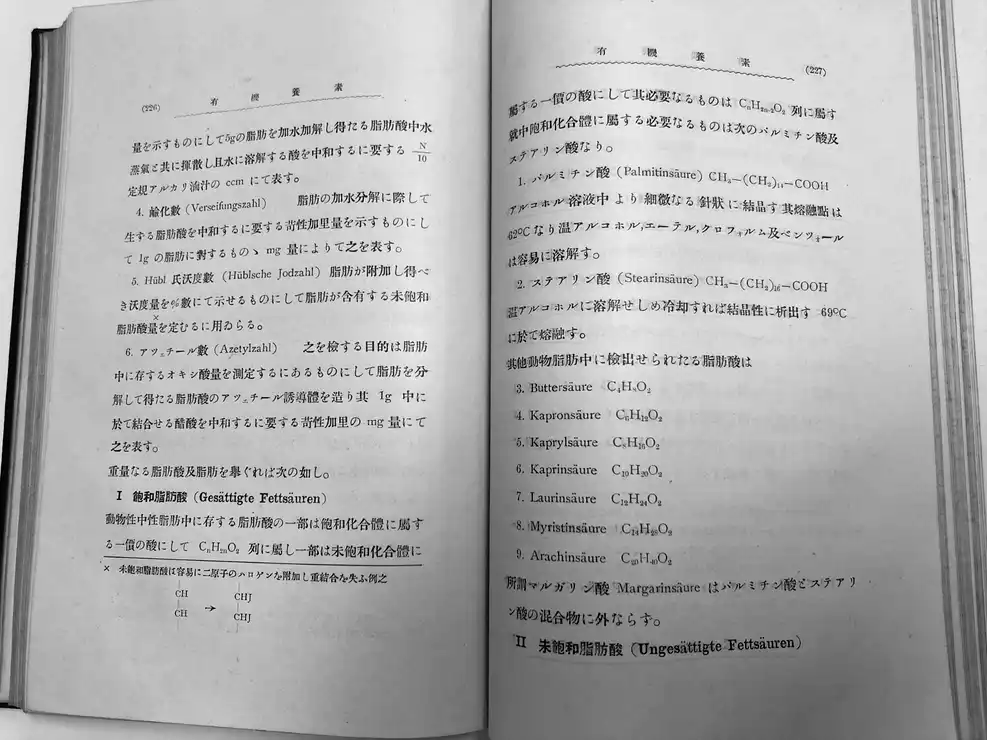
The historical source examined here is 有機養素 附 酵素 (Organic Nutrients, with an Appendix on Enzymes), written by Yashiro Kotake (古武彌四郎) and issued by Nankodo (南江堂). The photographed colophon gives the publication date as August 5, 1915. The photographs are of the reader's physical copy, not illustrations reconstructed from a modern textbook.

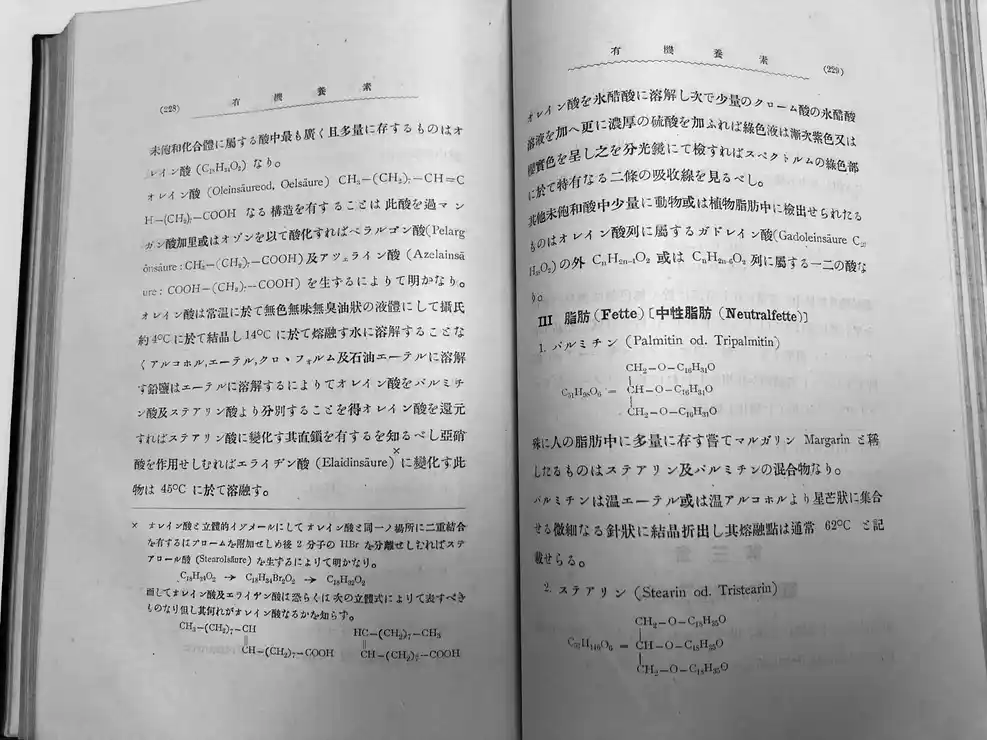
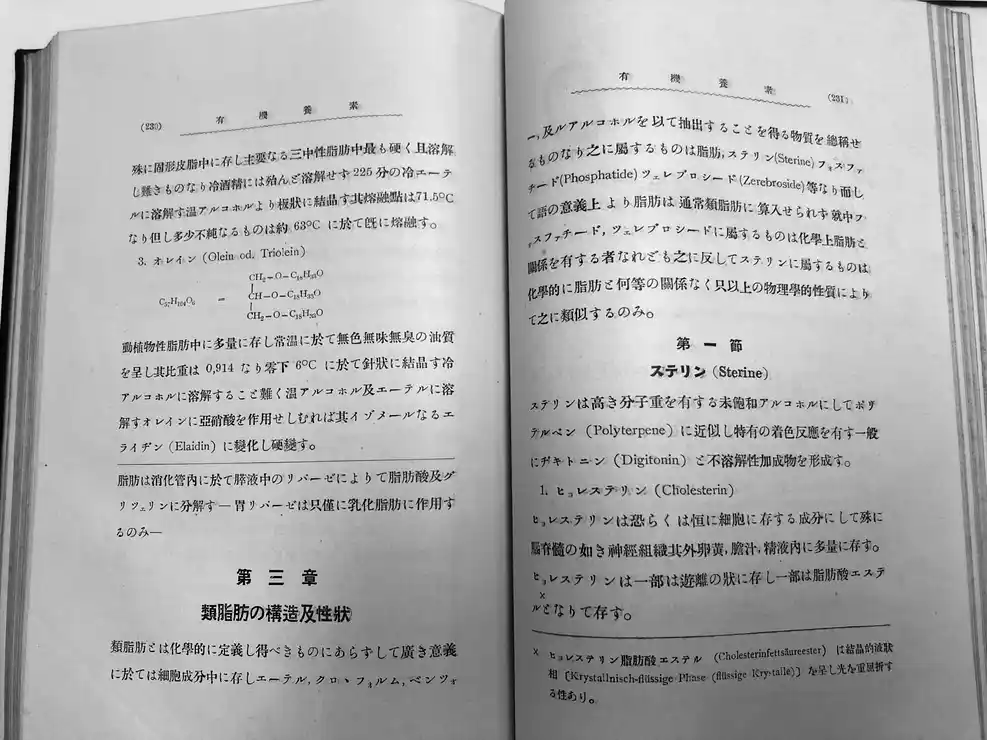
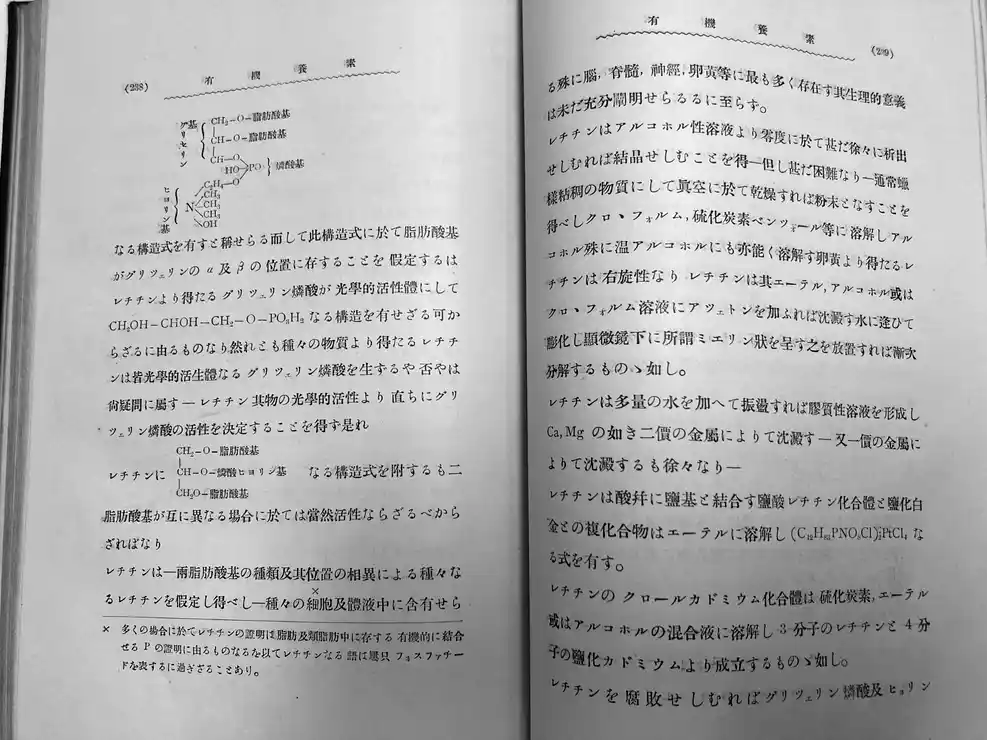
The evidence in the pages is striking for what was already established. By 1915, the text discussed saturated and unsaturated fatty acids, palmitic acid, stearic acid, oleic acid, glycerol esters (including triolein), fat emulsification, sterols and lecithin. It also presented laboratory-based ways of characterizing fats, including measurements related to their unsaturation and saponification. These topics were not invented by modern nutrition websites: their chemical foundations predate them by many decades.
| Topic | Visible in the photographed 1915 text | Modern framing |
|---|---|---|
| Saturated/unsaturated chains | Pages 226–229 list palmitic, stearic, and oleic acids. | Count/position/stereochemistry of C=C bonds; use 16:0, 18:0, 18:1 notation. |
| Glycerol esters | Pages 224 and 228–230 describe named fat esters, including triolein. | TAG molecular species and fatty-acyl composition, often analyzed by mass spectrometry. |
| Emulsification | Page 217 explicitly has an emulsification heading and discussion. | Distinguish droplet formation from pancreatic lipase hydrolysis and micellar absorption. |
| Lecithin | Pages 238–239 include chemical structure sketches. | Phosphatidylcholine molecular species and glycerophospholipid membrane biology. |
| Sterols | Pages 230–231 begin a sterol section naming cholesterol. | Sterol lipids are an independent lipid category, not fatty acids. |
What changed over the following century was molecular resolution, not the basic existence of these chemical concepts. Contemporary lipidomics can distinguish molecular species, positional isomers, and many lipid classes in biological samples. The original photographs support claims about the topics covered in the book; the modern biological interpretations here come from current references rather than being attributed to the 1915 author.
Saturated and Unsaturated Fats Practice Quiz
Try 10 randomized multiple-choice questions on fatty-acid structures, 18:0 vs. 18:1 vs. 18:2, cis/trans configuration, triglycerides, phospholipids and fat digestion. Every question has exactly three choices and one correct answer. You will see an explanation after each answer, including when an answer is incorrect, and you can always move to the next question.
Frequently Asked Questions
Are saturated fats always bad and unsaturated fats always good?
That is too simple. Dietary health depends on the food source, quantities, what replaces the fat, and the overall eating pattern. Public-health guidance generally recommends replacing some saturated fat with unsaturated fats rather than with industrial trans fats.
What is the difference between monounsaturated and polyunsaturated fat?
Monounsaturated fatty-acid chains have exactly one carbon–carbon double bond. Polyunsaturated chains have two or more. The difference is structural, not a claim about the purity of an entire food or oil.
Are omega-3 and omega-6 fats saturated or unsaturated?
They are families of polyunsaturated fatty acids. Omega numbering describes the position of the first double bond measured from the methyl end. α-Linolenic acid (18:3 n-3) is omega-3; linoleic acid (18:2 n-6) is omega-6.
What is the difference between a lipid and a fat?
“Lipid” is broader: it encompasses fatty-acyl compounds, glycerolipids, glycerophospholipids, sphingolipids, sterols, and other categories. In everyday dietary usage, “fat” often refers to mixtures rich in triglycerides. Not every lipid is a triglyceride.
Do triglycerides and phospholipids contain the same number of fatty-acyl chains?
Typical triacylglycerols have three fatty-acyl chains; common diacyl glycerophospholipids have two chains plus a phosphate-containing headgroup. Some phospholipids have different chain counts or ether-linked chains, so the two-chain rule is a common example rather than an absolute definition.
Does emulsification chemically break down fat?
No. Emulsification disperses fat into droplets; ester-bond hydrolysis is carried out by lipases. The processes work together during digestion but are not identical.
Continue Learning
For another interactive biochemistry activity, see our Enzyme Inhibition Guide and Quiz, which explains enzyme mechanisms using interactive graphs. You can also browse more science resources in BCC Magazine.
Sources and Editorial Notes
- Historical primary source: Kotake, Yashiro (古武彌四郎). 有機養素 附 酵素 (Organic Nutrients, with an Appendix on Enzymes). Nankodo (南江堂), 1915; photographed copy, colophon dated August 5, 1915; relevant pages 217–239. Bibliographic particulars were read from the photographed copy.
- LIPID MAPS: Lipid Classification System — definition and classification of fatty acyls, glycerolipids, glycerophospholipids, and sterol lipids.
- OpenStax Biology 2e: Lipids — fatty acids, triglycerides, phospholipids, and physical properties.
- MedlinePlus: Dietary Fats Explained — dietary roles and saturated/unsaturated fat definitions.
- American Heart Association: The Facts on Fats — general dietary fat-replacement guidance.
- NCBI Bookshelf: Fat Absorption and Lipid Metabolism — emulsification, lipase hydrolysis, and micellar absorption.
Editorial scope: Historical captions refer only to information directly visible in the reader-supplied photographs; modern chemical interpretation is independently referenced above. The interactive fatty-acid explorer is a teaching aid based on known formulas and common nomenclature, not a predictive thermodynamic model. This page provides general scientific and educational information, not personal nutrition or medical advice.